But none of that matters now. I look out at the hills and the lake again. I’ve been driving along these roads for nine decades, but I’m still struck by just how beautiful it is, and I never want to leave.
The days were quiet. They’re still here. I never thought they’d last. Through them, ran the sense—like an underground river… That there would come a time when these days would be looked back on as happiness: all that life could give of contentment and peace…
It still feels like we just live here, day to day. But isn’t that the beauty of it?… You know the rain comes down, the sun shines, grass grows. Children grow old, and die. That’s the holy all of it. We all know it full well, but can’t even whisper it…
So, you’re happy lad, is that what you are saying? We have our health. Peaceful life. Work that suits us. What more can you ask for?
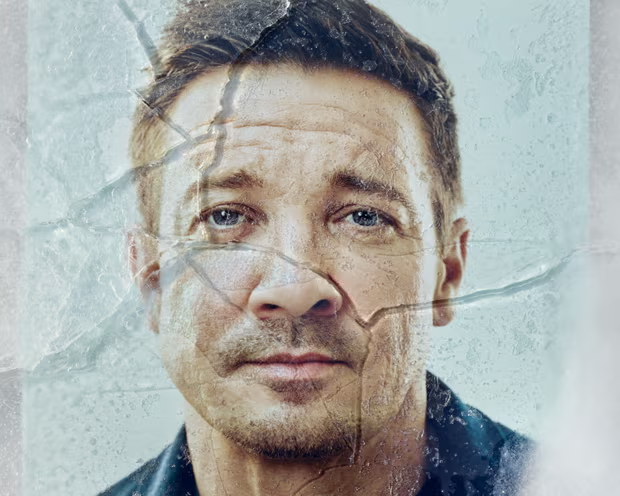
Six ribs broken in 14 places. Three breaks in the lower pelvis. Right and left ankle broken. Left tibia broken. Left wrist fractured. Left toes, three breaks. Right clavicle broken. Right shoulder blade cracked. Eye socket, jaw, mandible, all broken. Major laceration back of head. Lung collapsed. Liver pierced from rib bone. The inventory of Jeremy Renner’s injuries, documented by the twice Oscar-nominated movie star himself, was exhaustive. It was a miracle that the actor had survived; he had no right to. Renner had been crushed by his own 14,000lb (6,350kg) snowplough on New Year’s Day 2023. A neighbour who helped him at the scene believes he died momentarily. So does Renner. He tells me it was a very special moment.
“What I experienced when I passed was this collective divinity and beautiful, powerful peace. It is the most exhilarating peace you could ever feel. It’s the highest adrenaline rush. Everything stopped … maybe for 30 seconds, maybe a minute. It was definitive for me. It all made perfect sense.” Does he believe in God? “No. My dad’s a theologist and I studied all religions growing up, so I steer away from religions.” […]
But, of course, there was more to it than willpower. Last year, he released his second album of largely self-penned songs. Love and Titanium is about the accident, and so called because these are another two things that have helped him pull through – the love of family and friends, and the titanium that has helped fix all those broken bones. He was also extremely lucky. Nobody gave him much hope at the time. […]
The first song on Love and Titanium is called Lucky Man. “One day you just wake up / And finally realise / Life is so god damn beautiful / And I ain’t got nothin’ left to lose.” Renner tells me that it took him the accident to realise just how beautiful life was. Now, he says, he wakes up and knows he’s not going to have a bad day. No day alive is a bad day. But it didn’t used to be like that.
Anna wandered down to the sea. She knelt in front of some of the stone nest houses and peered in. Anna’s life here was, I was coming to see, devoted to paying attention to – or, more than that, being completely committed to – the beauty of the world before her. She seemed to have done it by cultivating an extraordinary form of independence from other people, their values, and their noise. She used every ounce of her willfulness to shut out the world and concentrate on these simple things. More and more, she reminded me of my grandfather. He spent many hours walking his farm and learning about the wild things upon it, like it was the most important work a human could do. Growing up, I’d wanted to be like him. And I was, for three or four years, after I left school. I’d go for walks over the fields; on sunny nights I’d sit with my back against a rock or climb into the lower branches of a tree and watch the world happening around me. I’d spend hours just watching deer or foxes or badgers, or swifts tumbling and screaming through the sky. I’d lie on my back in the grass and watch the swallows hawking after flies round my dad’s cows, or the brown hares playing in the meadows. But somewhere in the years since, I’d stopped being that person. Life was too busy to stand and stare. I became responsible for boring, necessary things. At one point I had three jobs and worked most nights and weekends. D. H. Lawrence once wrote that the industrial age had created a new kind of human, a machine-like man with iron in his soul. I had become one of them. The past few years had been swallowed up by striving. I remembered a friend back home trying to tell me, gently, that I had become almost manic. But the longer I spent with Anna, the more that way of being felt like a sickness I needed to recover from. A new calmness began to settle over me. It was a feeling I had not known since I was a child following my grandfather round his fields.
Anna reminded me that the first rule of living is to live. To see, hear, smell, touch, and taste the world. The more I tuned in, the closer Anna and I were growing as friends. I was beginning a journey back to the person I had once been – and needed to be again.
Book Review: A warming tale of gathering eiderdown in Norway. Shepherd’s Life author trades the Lake District for a remote island just below the Arctic Circle, where he joins an ‘unbreakable’ septuagenarian keeping an ancient family tradition alive.
Book Review in The Guardian: “Duck Tales. The Lakeland shepherd heads to a Norwegian island where eiderdown is harvested to learn lessons about nature and humanity”
Post Title & Inspiration: Aldous Huxley: “It’s dark because you are trying too hard. Lightly child, lightly. Learn to do everything lightly. Yes, feel lightly even though you’re feeling deeply. Just lightly let things happen and lightly cope with them.
Every leaf that falls never stops falling. I once thought that leaves were leaves. Now I think they are feeling, in search of a place— someone’s hair, a park bench, a finger. Isn’t that like us, going from place to place, looking to be alive?