Monday Morning Wake-Up Call: Take 2

So Stewart (Brand) gave birth to this idea that if we could show the world from the outside, if we realized what an amazing, extraordinary, unique gift that was — this tiny, little planet teeming with life, swimming around in a dead universe, as far as we know.

We still don’t know that there’s any other life in the universe, which is phenomenal, if you think about it. We still don’t know. We might be the only life in the universe. I think about that nearly every day. I think it’s the most sobering thought. I think that should be shouted from the rooftops every day.

That’s my version of seeing the whole Earth from space — getting people to understand that we might be the only life. It might all be on this one place, and bloody hell, shouldn’t we look after it a bit better, then?

Then those things make me constantly think and constantly be grateful for the fact that I’m alive. I remember reading this comment from a New York taxi driver. He’s driving, and he turns to the customer and says, “Oh, life. I’m so glad I got in.” [Laughs.]

I just love the idea that it’s like an amazing show at a theater and you managed to get a ticket to see it. I appreciate that kind of gratitude.

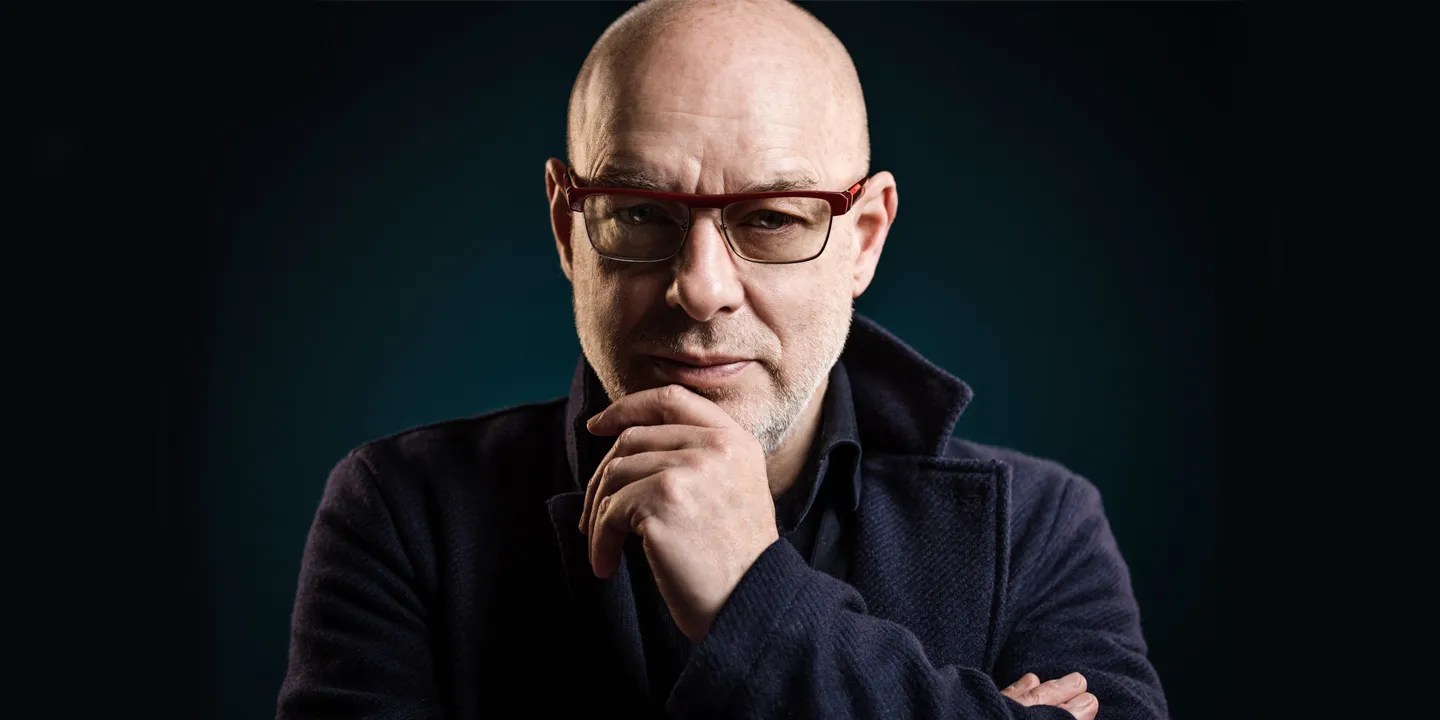
Brian Eno interviewed by Ezra Klein, from “A Breath of Fresh Air with Brian Eno” (NY Times, October 3, 2025. The Ezra Klein Show)


Brian Eno Portrait by Shamil Tanna @ Pitchfork.com

Monday Morning Wake-Up Call

EK: So what does art do? Why do we like it?

BE: One of the things that happen when you are looking at art or listening to art — something connects to you, and you think, “That’s what I really like. That’s what really moves me.” … I think some of the worst writing in the world is writing about fine art, and it ought to be much simpler. One of the reasons you like it is that it doesn’t translate into words. It doesn’t turn into sentences. It hits you in some other place, some other part of your mind. […]

EK: I always think about that as being on an album called “Music for Airports” because that is both very discordant and, as I thought about it more, exactly correct. That is, to me, one of the holiest pieces of music I have ever heard. And in a way, it gets to something true about airports, which is that this is a place where human beings go to fly, where they’re forced into — I mean, I feel this when I get on planes — a confrontation with their own mortality. There’s never a time when I’m in a plane that is having turbulence during takeoff when I don’t think — in a way I usually do not think in my day — “I could die.” There are all these people, they’re going to places that are, in many cases, incredibly important to them, and the airport is this extraordinary combination of a place that is so banal — lines, and you’re waiting in line for food that is mediocre, at best, and you’re late, and your plane is late, and you’re annoyed. And then it’s also the absolute most remarkable place that a human being can possibly find themselves — something that, for most of human history, was completely unimaginable. “2/1” on “Music for Airports,” to me, is such a perfect song because it’s more true about the airport than my experience of the airport is.

BE: [Laughs.] That’s a nice way of putting it. I wanted to make flying feel like a more spiritual experience, if I had to put it into a sentence with a controversial word in it. And by that I mean I used to be very frightened of flying, and of course, I had to do it at that time in my career.

But I thought: What if you could make a kind of music that made you less worried about the idea of dying? What if you could make a piece of music that made your life seem less the center of your attention? If you could see yourself as just being one atom in a universe of complicated molecules, would that make things feel better?

Brian Eno interviewed by Ezra Klein, from “A Breath of Fresh Air with Brian Eno” (NY Times, October 3, 2025. The Ezra Klein Show)

Monday Morning Wake-Up Call

At the Marlboro Music School and Festival this summer, my fellow musicians and I spent an evening listening to historical recordings, an annual tradition. We ended with the slow movement of Beethoven’s String Quartet (Op. 127), performed by the Busch Quartet, refugees from Hitler’s Germany.

This music is as profound as can be. From the first notes, I was in tears. Time was suspended, and nothing else existed. When it ended, I quietly left the room. Making polite conversation would have brought me back to earth; I wasn’t ready.

What I had experienced was complete immersion into music.

Most of life’s great moments are like this. We give our full attention to one thing, and marvel at its beauty and strangeness and specificity. Past disappointments and future worries evanesce, allowing us to take in the present in its totality.

But in today’s frenetic world, such moments are increasingly hard to come by. We should consider how rare and treasurable this kind of immersion is. […]

All sorts of people more qualified than I — sociologists, political scientists and media critics — have addressed the pernicious effects of social media and algorithmic marketing on our society and psyches. But I can testify that music is uniquely well positioned to provide an antidote to this avalanche of stimulus.

You may prefer literature or painting as art forms, but they do not have music’s magnificent, peculiar abstraction. Novels use words; even an abstract expressionist painter relies on colors and shapes that exist in nature and our lives. But instrumental music is not “about” anything. It stirs the emotions despite — or maybe because of — its inability to reference our lived experience in any literal way. A great performance of a great piece of music simultaneously takes us out of our heads and puts us in touch with our deepest, most inaccessible selves. That is the magic of music. […]

As I listened to this astonishing music in the Marlboro dining hall, I never opened my eyes. This was an instinct. I sensed an opportunity to be connected to something profound and beautiful and in no way ordinary, and I did not want to let my other senses intrude on the experience. In our splintered, combustible world, this immersion is the path of most resistance, and a gift beyond words.

Jonathan Bliss, from “Too Many Dings and Beeps? Try Beethoven” (NY Times, Sept 28, 2025)

Mr. Biss is a concert pianist and co-artistic director of the Marlboro Music School and Festival


Portrait: OC87 Recovery Diaries. Photographer: Benjamin Ealovega

Walking. These boots are made for walkin’…

I don’t stroll. I don’t meander. Or stop to catch-up. Or walk sipping coffee. I don’t sit on park benches contemplating my fate.

Move fast, talk straight, get it done. Next! #BePatient? Ahhhh, no.

Late March. It’s still fresh, oh so very fresh. I’m marching through the Park at 4 a.m., pre-dawn, usual story. Just another morning on the same path I’ve walked a thousand + times. Pitch black.

Kate Fagan: “You just never f****** know what’s going to happen next in this life—okay?

I walk…

These boots are made for walkin’
And that’s just what they’ll do
One of these days, these boots are gonna walk all over you (Nancy Sinatra, 1966)

Nope, I didn’t see it. No sixth sense, no gut intuition, no unconscious memory map of treacherous obstacles.

My toecap catches a large rock, and I’m airborne. Yes, in that split second, it was all in slow motion. Instinctively, the body did respond:

  1. Clutch cameras (PROTECT THE GEAR AT ALL COSTS NO MATTER WHAT DAMAGE TO BODY)
  2. WAIT! Wait just one millisecond. I can’t FACE-PLANT. I twist my right shoulder inward to absorb the blow.
Continue reading “Walking. These boots are made for walkin’…”

Two billion heartbeats and…

Paul Simon, 83, has simply changed his mind about a farewell to touring that he announced in 2018, with a valedictory arena tour that ended with a park concert in Queens. He had more to say and sing.
He’s back on the road with a relatively intimate, scaled-down postscript: his A Quiet Celebration tour. It’s booked into theaters selected for their acoustics, and it’s made possible by an advanced monitoring system that helps him cope with his recent severe hearing loss. […]

In 2023, Simon released “Seven Psalms,” a continuous 33-minute suite of songs about the brevity, fragility and preciousness of life — “Two billion heartbeats and out / Or does it all begin again?” […]

He opened his Beacon Theater concert with a full performance of that album wearing a blazer, without his usual ball cap. The suite’s sections are loosely held together by delicate guitar picking patterns, recurring vocal lines and occasional refrains. But they also explore enigmatic tangents and dissolve into abstract sounds. In the best way, “Seven Psalms” sounds like someone thinking aloud, melodically and philosophically. […]

Between songs, Simon spoke about musical constructions. He teased instantly recognizable “guitar figures” from Simon & Garfunkel songs before playing a weary, countryish version of his touring-musician’s lament, “Homeward Bound.” He explained “Rewrite” — sung by a burned-out character wishing he could rewrite his life story — as growing out of a beat and a quick-fingered guitar lick.

Simon’s songs have had grown-up concerns for decades. He sang about parenthood in “Graceland” and “St. Judy’s Comet.” He sang about inevitable disillusionment in “Slip Slidin’ Away.” He sang about reluctant breakups, wistfully, in “Train in the Distance” and drolly in “50 Ways to Leave Your Lover.” And after explaining how he saw a song title in a photo caption, he sang about romance, art, consumerism and the power of music in “Rene and Georgette Magritte With Their Dog After the War,” in the pointillistic arrangement from his 2018 album “In the Blue Light.”

His reedy voice is weaker and scratchier than it once was, but he was still game, reaching for high notes in “Slip Slidin’ Away” and “Me and Julio Down by the Schoolyard.” The restrained volume and the age of the audience made the room reluctant to sing along until near the end of the set. But when “50 Ways to Leave Your Lover” arrived, and when Simon suggested “Sing!” during “The Boxer,” loud singalongs sprang up. For all his intricacies, he always knew how to write a hook.

Jon Pareles, excerpts from “Paul Simon at the Beacon Theater: Quiet, Intricate, Masterly (NY Times, Jun 17 2025)


Photo: jambands.com