And yet the morning washes everything away… I think, where would humanity be without morning? Even the most violent need is calmed by dawn, and you can almost catch the fresh scent of hope. The day is a child before it ages and it ages very quickly here, making those early hours all the more miraculous.
Just finished this book. Highly Recommended. Here’s an additional passage: “I became, in silent and private ways, powerfully aware of the fragility of all that I treasured: my family, my very sense of myself, the future I allowed myself to expect.” And another: “I had my own words, blades packed in the mouth, capable of cutting my tongue wide open. I feared speaking them and feared not speaking them, and I knew that, like all things of consequence, they could not be postponed or stored away for later use. If I missed my opportunity now, I thought, I would have to carry those words unspoken forever. Sounds in the dark.” And one last one: “A thousand and one things could befall us and the people we love the most would have no hint of it. Which is why we must remain close to them, within an arm’s length.”
Photo: DK this morning February 4, 2024 at Cove Island Park @ 6:33 a.m, 28° F feels like pretty damn cold. More photos from this morning here and here.
Recently, while browsing in the Museum of Modern Art store in New York, I came across a tote bag with the inscription, “You are no longer the same after experiencing art.” It’s a nice sentiment, I thought, but is it true? Or to be more specific: Does consuming art, music, literature and the rest of what we call culture make you a better person?
Ages ago, Aristotle thought it did, but these days a lot of people seem to doubt it. Surveys show that Americans are abandoning cultural institutions. Since the early 2000s, fewer and fewer people say that they visit art museums and galleries, go to see plays or attend classical music concerts, opera or ballet. College students are fleeing the humanities for the computer sciences, having apparently decided that a professional leg up is more important than the state of their souls. Many professors seem to have lost faith too. They’ve become race, class and gender political activists….
And yet I don’t buy it. I confess I still cling to the old faith that culture is vastly more important than politics or some pre-professional training in algorithms and software systems. I’m convinced that consuming culture furnishes your mind with emotional knowledge and wisdom; it helps you take a richer and more meaningful view of your own experiences; it helps you understand, at least a bit, the depths of what’s going on in the people right around you…
I’d argue that we have become so sad, lonely, angry and mean as a society in part because so many people have not been taught or don’t bother practicing to enter sympathetically into the minds of their fellow human beings. We’re overpoliticized while growing increasingly undermoralized, underspiritualized, undercultured. The alternative is to rediscover the humanist code. It is based on the idea that unless you immerse yourself in the humanities, you may never confront the most important question: How should I live my life? …
I went to college at a time and in a place where many people believed that the great books, poems, paintings and pieces of music really did hold the keys to the kingdom. If you studied them carefully and thought about them deeply, they would improve your taste, your judgments, your conduct…
The hard sciences help us understand the natural world. The social sciences help us measure behavior patterns across populations. But culture and the liberal arts help us enter the subjective experience of particular people: how this unique individual felt; how this other one longed and suffered. We have the chance to move with them, experience the world, a bit, the way they experience it.
Mark Edmundson teaches literature at the University of Virginia and is one of those who still lives by the humanist code. In his book “Why Read?” he describes the potential charge embedded in a great work of art: “Literature is, I believe, our best goad toward new beginnings, our best chance for what we might call secular rebirth. However much society at large despises imaginative writing, however much those supposedly committed to preserve and spread literary art may demean it, the fact remains that in literature there abide major hopes for human renovation.”
Wouldn’t you love to take a course from that guy?
How does it work? How does culture do its thing? The shortest answer is that culture teaches us how to see. “The greatest thing a human soul ever does in this world is to see something, and tell what it saw in a plain way,” the Victorian art critic John Ruskin wrote. “Hundreds of people can talk for one who can think, but thousands can think for one who can see.”
Masao Yamamoto, 66, is a Japanese freelance photographer known for his small photographs, which seek to individualize the photographic prints as objects. This photograph is titled “Kawa=Flow #1664, 2016” and is a 5.25 x 8.06 inch gelatin silver print.
Notes:
Post Title from Simon Waley’s: The Joys of Photography in BBC Countryfile. “Photography becomes a record of our journey through life. It captures the moments that stirred our emotions. They reflect our view of the world and our place within it. Photos help us express our creativity and share those visions. They become the tools for evoking memories and telling stories. And all it takes is a simple click.“
Church. My sister is one of the servers. Unaware that I’m there, she approaches the spot at the altar rail where I’m kneeling with my hands out. She stops in front me, carrying the big silver chalice, looks down, recognises me. She rocks back on her heels, her face is still with astonishment, then she smiles and I have to keep my eyes on her black shoes. My lips quiver against the rim of the chalice so hard that I’m afraid I won’t be able to swallow.
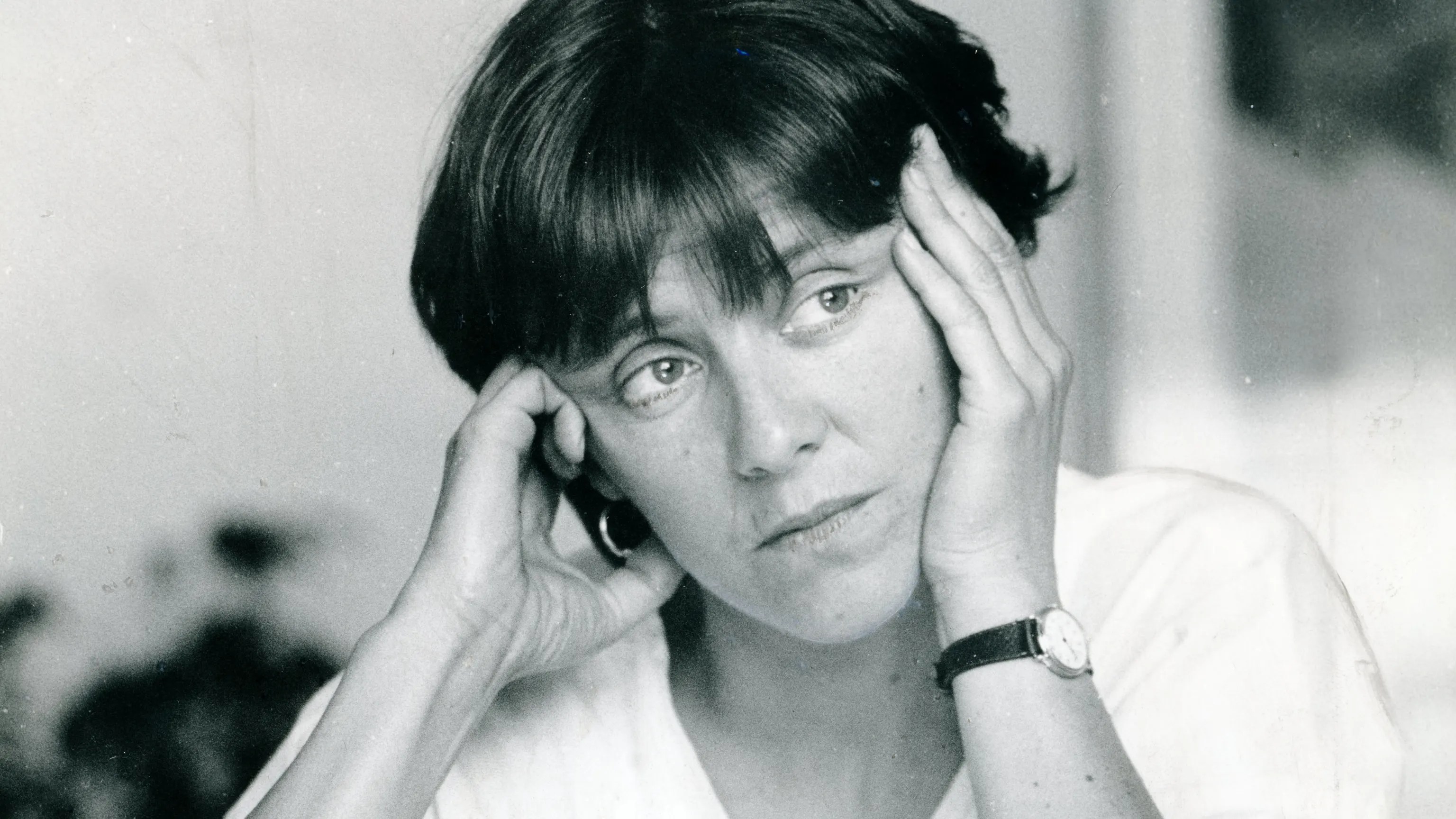
Notes: Portrait of Helen Garner in 1984 by Ray Kennedy via smh.com.au. ‘A poet in plain prose’: Reflection on Helen Garner’s amazing opus by Kerrie O’Brien.
I hit a low point today. I felt I could not go on. It was like knowing that a free garden, calm and full of rest, lay on the other side of a wall. I knew where the gate was, I could walk through it whenever I felt like it. I was withholding release from myself. Then I had a coffee and a cake, went back to the desk, forced a solution, and kept going.
Portrait via Inside Story. “Garner Territory” by Zora Simic: “In one of the most remarkable entries, in the thick of torment, Garner envisions a new life for herself… “Sometimes we know what we want even when we think we want something else.” Another friend declares, “I think these diaries are the best thing she’s ever written.” I agree; they are her life’s work, and the ideal mode for a “writer who works off and is nourished by the events of daily life.” •
Post Title & Inspiration: Aldous Huxley: “It’s dark because you are trying too hard. Lightly child, lightly. Learn to do everything lightly. Yes, feel lightly even though you’re feeling deeply. Just lightly let things happen and lightly cope with them.