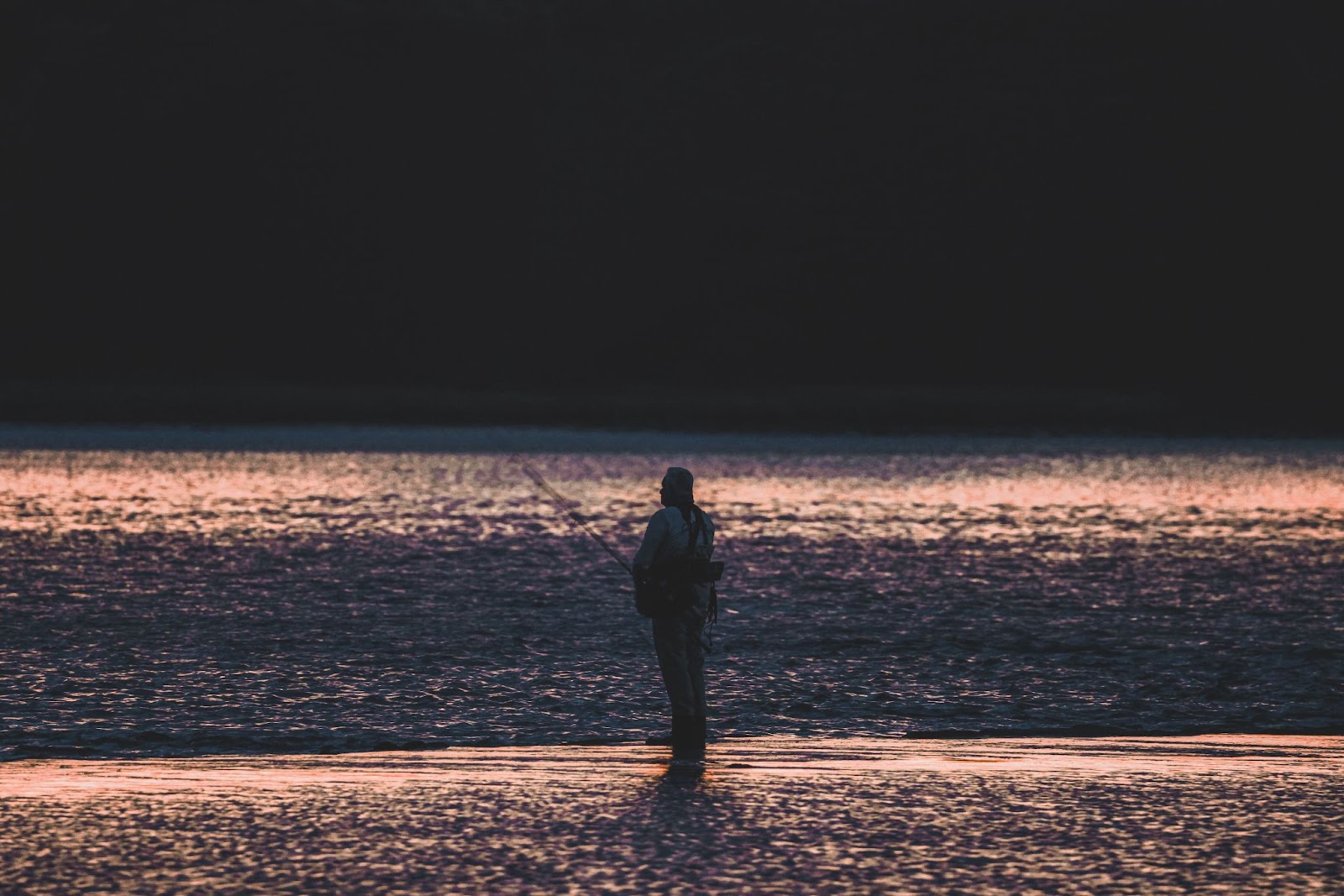
DK Photo – May 31, 2024 @ 5:39 am at Cove Island Park. More photos from that morning here.
Thursday Posts inspired by Aldous Huxley: “It’s dark because you are trying too hard. Lightly child, lightly. Learn to do everything lightly. Yes, feel lightly even though you’re feeling deeply. Just lightly let things happen and lightly cope with them.
It’s 2 a.m., and Wally’s licking my arm: “Sorry Dad,” he says, “Gotta go.” “Jesus, Wally, now?” And that was the end of that.
I turn to the morning papers, blog posts and RSS feeds. Kaveh Akbar’s words echo: “Time flattens everything. Family, duty, whatever…There’s something comforting about that, something vast and, yes, inescapable. Like bright ink spilling over everything at once.”
I pull into the parking lot. Sigh, another day, another walk.
1502 consecutive (almost) days on my Cove Island Park morning walk. Like in a row.
I walk.
Eyes burn, fatigue has set in.
65° F, 10 mph winds from the north — I immediately regret not bringing a windbreaker. Left it resting on the front seat of the car.
I’m dragging my a** around the track, directly into the headwinds. Shiver. I could turn back, walk ¼ mile to the car, and grab the jacket. But that simple turn, a few hundred steps back, just seemed to be too much.
Swans are the gentle giants of my local waterways: floating paragons of snowy serenity that cruise peacefully through muddy brown water amid the rowdy confusion of their smaller brethren.
And they present a puzzle. Around them, mallards, Egyptian geese and Mandarin ducks have plumage so varied that it seems like any little speck of dirt or grime would disappear into the design. But the swans, paddling around in water so opaque that their feet can’t be seen, tip their tail feathers high in the air to forage underwater for the deepest plants—yet they re-emerge an unreasonably pure white. How do they stay so clean?
[…]
Just as a swan uses an oily coating to repel water, to get rid of oil it needs a watery coating. And the answer—discovered only three years ago in a paper published in the journal Advanced Functional Materials—is saliva. A swan’s spit is full of proteins that have a water-loving end and an oil-loving end. Once in a while, the bird distributes saliva on its feathers instead of preen oil, and the oil-loving ends stick to the feathers, leaving the water-loving ends exposed.
This makes the feathers attractive to water, and so allows the watery saliva to penetrate deep into the feathers. Once it’s there, it finds channels lined with tiny wedges. The wedge shapes help surface tension push the water from the center of the feather to the edges, sweeping along and clearing out any tiny droplets of oil or fat on the way.
The feathers get a watery deep cleaning as the tiniest oily contaminants are carried away. After a while, air dries the saliva out, and the surface returns to its normal water-hating state while the swan is restored to its pristine purity.
It’s a fascinating system, and scientists and engineers are now trying to replicate it to make self-cleaning fabrics that we could use. But kudos to the swan, for having evolved the perfect spit-and-sparkle system for keeping itself clean.
…clouds remain one of the least understood—or least reliably predictable—factors in our climate models…
“They are among the biggest uncertainties in predicting future climate change,” Da Yang, an atmospheric scientist at the University of Chicago, told me.Yang is a cloud expert—a cloud guy, really, drawn to their mysteries. He recently moved from California to Chicago, where he gets to see a lot more clouds on a daily basis. “I find clouds are beautiful to watch,” he said. “If I take an airplane, and I can see clouds down below or far away, I’m always fascinated by how rich the cloud organizations are. How they interact with each other …” He trailed off. Clouds are complex and ephemeral, which makes them difficult to fully understand. Yang listed for me key aspects of clouds for which we still lack comprehensive understanding: how they form, what determines their spatial scale, how long they can last. “Those sound like simple questions,” he said, “but they are actually at the forefront of the field.” […]
One major stumbling block is the resolution of climate models, or how finely or coarsely they represent the Earth; to represent individual clouds, which can be the size of a minivan or the state of Minnesota, would require models at a resolution finer than the current finest model. Climate modelers have recently begun to produce fine-scale models at the regional level, where they can zoom in on the individual details of clouds. But, Yang told me, stitching such snapshots together into a picture of the whole globe would exceed the capacity of the largest existing supercomputer……
Photo: Henri-Chapelle Cemetery, Belgium by Ralph Morse published in TimeLife Magazine in 1946.
This verse (The Kohima Epitaph) is engraved on the Memorial of the 2nd British Division in the cemetery of Kohima (North-East India). The verse is attributed to John Maxwell Edmonds (1875-1958), and is thought to have been inspired by the epitaph written by Simonides of Ceos to honour the Greeks who fell at the Battle of Thermopylae in 480BC. (Source: British Legion). Thank you Beth for sharing.